

 Read article 'Charmless baryonic B decays'
Charmless baryonic B decays
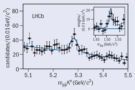
The LHCb collaboration has made the first sightings of the decay of B mesons into two baryons containing no charm quarks.
 Read article 'Charmless baryonic B decays'
The LHCb collaboration has made the first sightings of the decay of B mesons into two baryons containing no charm quarks.
 Read article 'GERDA sets new limits on neutrinoless double beta decay'
The GERDA collaboration has obtained new strong limits for neutrinoless double beta decay, which tests if neutrinos are their own antiparticles.
 Read article 'T2K observes νμ→νe definitively'
The international T2K collaboration chose the EPSHEP2013 meeting in Stockholm as the forum to announce its definitive observation of the transformation of muon-neutrinos to electron-neutrinos, νμ→...
 Read article 'EPS-HEP2013: these are good times for physics'
Stockholm, with its many stretches of water, islands and old town, provided an attractive setting for the 2013 International Europhysics Conference on High-Energy Physics, EPS-HEP2013 on 18–24 July.
 Read article 'ALICE goes to Stockholm and Birmingham'
The ALICE collaboration had a significant presence at two recent major conferences: EPSHEP 2013 and SQM2013
Read article 'The LHC’s first long run'
Summary of the first run of the LHC with recognition to the people who wrote for the CERN Courier during this period.
 Read article 'US high-field quadrupole magnet passes test'
The US LHC Accelerator Program (LARP) has successfully tested a powerful superconducting quadrupole magnet that will play a key role in developing a new beam-focusing system for the LHC.
 Read article 'IceCube detects ultra-high-energy events and observes oscillations'
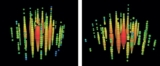
Neutrino experiments – thanks to the nature of the particles themselves – are notoriously difficult and experiments that make use of the natural source of particles within the cosmic radiation fac...
 Read article 'ISOLDE experiments: from a new magic number to the rarest element'
Two teams working on experiments at CERN’s ISOLDE facility have published results that extend knowledge in different areas of nuclear and atomic physics.
 Read article 'CMS sees first direct evidence for γγ→WW'
In a small fraction of proton collisions at the LHC, the two colliding protons interact only electromagnetically, radiating high-energy photons that subsequently interact or "fuse" to produce a pair o...