

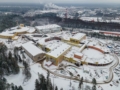
 Read article 'NICA booster achieves first beam'
NICA booster achieves first beam
The booster synchrotron at Russia's NICA accelerator complex accelerated helium ions in late December.
 Read article 'NICA booster achieves first beam'
The booster synchrotron at Russia's NICA accelerator complex accelerated helium ions in late December.
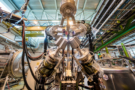 Read article 'Nuclear win for ISOLDE physicists'
A trio of ISOLDE physicists have been awarded the 2020 Lise Meitner Prize.
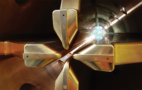 Read article 'Spiralling into the femtoscale'
The SPIRAL2 facility at GANIL will probe short-lived heavy nuclei and address applications in fission and materials science.
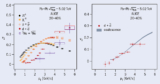 Read article 'Fragile light nuclei flow through freeze-out'
The ALICE collaboration recently reported the first measurement of the triangular flow of deuterons in Pb–Pb collisions.
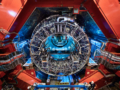 Read article 'ALICE’s dark side'
Precision measurements of the production and annihilation of light antinuclei are sharpening the search for dark matter.
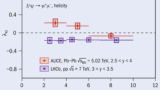 Read article 'J/ψ polarisation differs in lead collisions'
Work now turns to connecting such observations with the known suppression and regeneration mechanisms in heavy-ion collisions.
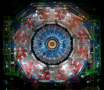 Read article 'CMS reaffirms exotic nature of the X(3872)'
The tetraquark candidate could be a bound state of a charm-up diquark and its anti-diquark.
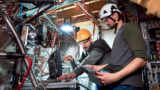 Read article 'Exploring nuclei at the limits'
Studies using traps and lasers not only help researchers understand nuclear structure, but also offer new ways to look for physics beyond the Standard Model.
 Read article 'Tetraquarks back in the spotlight'
A hidden-double-charm tetraquark observed recently by LHCb has reinvigorated the debate over whether tetraquarks are pairs of mesons or pairs of diquarks.
 Read article 'Common baryon source found in proton collisions'
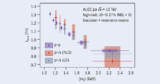
The ALICE collaboration recently used p–p and p–Λ pairs to perform the first study of the particle-emitting source for baryons produced in pp collisions.