

 Read article 'New pentaquarks resolved by LHCb'
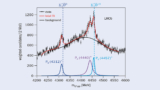
New pentaquarks resolved by LHCb
The LHCb data also confirm that the structure previously reported by the collaboration in 2015 has now been resolved into two narrow, overlapping peaks.
 Read article 'New pentaquarks resolved by LHCb'
The LHCb data also confirm that the structure previously reported by the collaboration in 2015 has now been resolved into two narrow, overlapping peaks.
 Read article 'Bottomonium suppression in lead–lead collisions'
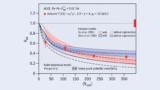
The quarkonium yield is suppressed in heavy-ion collisions when compared with proton–proton collisions because the binding force is screened by the hot and dense medium.
 Read article 'CASTOR calorimetry delves into gluon saturation'
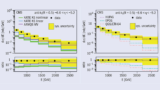
This largely unexplored phenomenon is expected to occur when the gluons in a hadron overlap transversally, and is enhanced for hadrons with high atomic numbers.
 Read article 'New measurements shine a light on the proton'
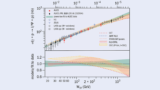
The ALICE collaboration has measured the photoproduction of J/ψ mesons.
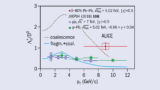 Read article 'Λc+-baryon probes charm-quark hadronisation'
This is essential to understand how charm-quark hadronisation is affected by the presence of the quark–gluon plasma.
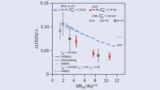 Read article 'Suppression of the Λ(1520) resonance in Pb–Pb collisions'
Due to their short lifetimes, they decay when the system is still dense and the decay products scatter in the hadron gas, reducing the observed number of decays.
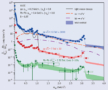 Read article 'First low-mass dielectron results ahead of LHC Run 3'
In contrast to strongly interacting hadronic probes, dielectrons provide an unperturbed view into the quark–gluon plasma.
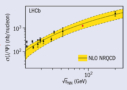 Read article 'Fixed-target physics in collider mode at LHCb'
The LHCb fixed-target system, known as SMOG, injects a small amount of noble gas inside the LHC beam pipe.
 Read article 'Electron–ion collider on the horizon'
The National Academy of Sciences in the US finds a compelling scientific case for an advanced collider that would reveal how visible matter emerges from fundamental quarks and gluons.
 Read article 'Probing quark–gluon plasma with charmed mesons'
The ALICE collaboration has released a new measurement of the production of D mesons.