

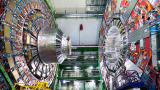
 Read article 'CMS observes top–antitop excess'
CMS observes top–antitop excess
The signal could be caused by a quasi-bound top–antitop meson commonly called "toponium".
 Read article 'CMS observes top–antitop excess'
The signal could be caused by a quasi-bound top–antitop meson commonly called "toponium".
 Read article 'Do muons wobble faster than expected?'
With a new measurement imminent, the Courier explores the experimental results and theoretical calculations used to predict ‘muon g-2’ – one of particle physics’ most precisely known qu...
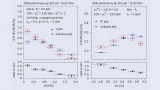 Read article 'CMS peers inside heavy-quark jets'
The CMS collaboration has shed light on the role of the quark mass in parton showers.
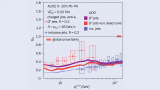 Read article 'Charm jets lose less energy'
New results from the ALICE collaboration highlight the quark-mass and colour-charge dependence of energy loss in the quark-gluon plasma.
 Read article 'Probing the quark–gluon plasma in Nagasaki'
The 12th edition of the International Conference on Hard and Electromagnetic Probes attracted over 300 physicists to Nagasaki, Japan.
 Read article 'Isospin symmetry broken more than expected'
The NA61/SHINE collaboration have observed a strikingly large imbalance between charged and neutral kaons in argon–scandium collisions.
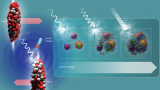 Read article 'The other 99%'
Daniel Tapia Takaki describes how ultraperipheral collisions mediated by high-energy photons are shedding light on gluon saturation, gluonic hotspots and nuclear shadowing.
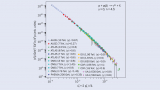 Read article 'Isolating photons at low Bjorken x'
A new measurement by ALICE will help to constrain the gluon PDF.
 Read article 'First signs of antihyperhelium-4'
Hypernuclei remain a source of fascination due to their rarity in nature and the challenge of creating and studying them in the lab.
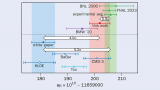 Read article 'Shifting sands for muon g–2'
Two recent results may ease the tension between theory and experiment.