

 Read article 'Astronomers spot first failed supernova'
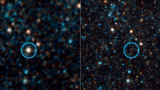
Astronomers spot first failed supernova
Findings suggest the star N6946-BH1 directly collapsed into black hole.
 Read article 'Astronomers spot first failed supernova'
Findings suggest the star N6946-BH1 directly collapsed into black hole.
 Read article 'LHC back with a splash'
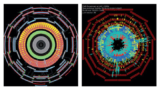
On 29 April, just after 8.00 p.m., the Large Hadron Collider (LHC) began circulating beams of protons for the first time this year. Extensive technical and maintenance work was undertaken since its en...
 Read article 'Workshop puts advanced accelerators on track'
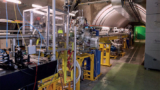
Researchers working on advanced and novel accelerator technologies met at CERN on 25–28 April to draw up an international roadmap for future high-energy particle accelerators. Organised by the Inte...
 Read article 'CAST experiment constrains solar axions'
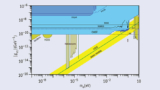
The CERN Axion Solar Telescope has reported important new exclusion limits on coupling of axions to photons.
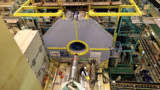 Read article 'Belle II rolls in'
On 11 April, the Belle II detector at the KEK laboratory in Japan was successfully “rolled-in” to the collision point of the upgraded SuperKEKB accelerator, marking an important milestone for the ...
 Read article 'CERN on the road'
The project will integrate the laboratory better into the local urban landscape.
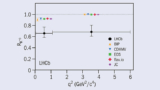 Read article 'LHCb finds new hints of Standard Model discrepancy'
At a seminar at CERN on 18 April, the LHCb collaboration presented new results in flavour physics that show an interesting departure from Standard Model (SM) predictions. The new measurement concerns ...
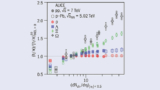 Read article 'Proton–proton collisions become stranger'
Recreating the intense fireball of quarks and gluons that existed immediately after the Big Bang, the quark–gluon plasma (QGP), traditionally requires high-energy collisions between heavy ions such ...
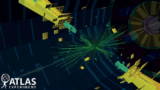 Read article 'ATLAS explores the energy frontier'
Utilising pairs of jets (dijets), a recent ATLAS search was able to probe the highest invariant mass of any of its searches, measuring events with energies as high as 8.1 TeV.
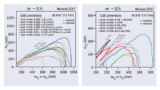 Read article 'SUSY searches in the electroweak sector'
CMS has recently reported searches for electroweak production of neutralinos and charginos in different final states.