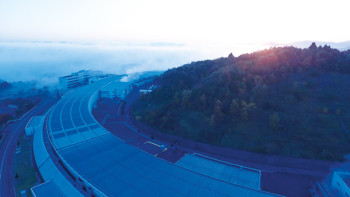

 Read article 'Electrons and nuclei meet at HERA'
Electrons and nuclei meet at HERA
The HERA collider at DESY, Hamburg, has been operating with proton and electron (or positron) beams since it was commissioned in 1991.
 Read article 'Electrons and nuclei meet at HERA'
The HERA collider at DESY, Hamburg, has been operating with proton and electron (or positron) beams since it was commissioned in 1991.
 Read article 'A decade celebrated at Dubna'
The Laboratory of Particle Physics of the Joint Institute for Nuclear Research, Dubna, Russia, is celebrating its 10th anniversary.
 Read article 'Physicists study photon structure'
Almost a century after Einstein introduced the idea of a quantum of light, the photon continues to be a rich field of physics.
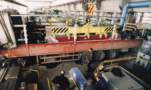 Read article 'From Russia with load'
Arriving at CERN from Novosibirsk's Budker Institute are magnets for the two transfer lines to feed the LHC collider with protons from the SPS proton synchrotron.
Read article 'Chandra blasts off'
An X-ray equivalent of the Hubble Space Telescope, the Chandra X-ray observatory, was launched on 23 July. Astronomers look forward to a new view of the violent universe with the highest-quality image...
Read article 'Astrowatch'
Gemini to see furthest stars Cosmology gains a twin as the first of two new international telescopes starts observations. The Gemini pair will explore the skies in both the northern and southern hemis...
 Read article 'New Fermilab machine dedicated'
The world's newest particle accelerator Fermilab's 150 GeV main injector officially began its career on 1 June.
 Read article 'LEP hits 100'
CERN's LEP electronpositron collider walked onto the stage for its 1999 season and, after its customary greeting at the Z resonance (45 GeV per beam), impressed the waiting audience by quickly takin...
 Read article 'Magnetic detector sees cosmic-ray anomalies'
From 2 to 12 June 1998, AMS was the primary payload of NASA's Space Shuttle Discovery in orbit 400 km above the Earth.
 Read article 'Accelerating power for LHC'
For CERN's new LHC proton collider, superconducting magnets will not be the only super- conducting technology in the 27 km ring.