

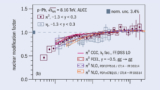
 Read article 'Light neutral mesons probed to high pT'
Light neutral mesons probed to high pT
The measurements constrain predictions from perturbative quantum chromodynamics.
 Read article 'Light neutral mesons probed to high pT'
The measurements constrain predictions from perturbative quantum chromodynamics.
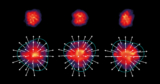 Read article 'Going with the flow'
The ALICE experiment is making strides towards understanding how charm and beauty quarks flow within cooling droplets of quark–gluon plasma at the LHC, shedding light on the extreme conditions of th...
 Read article 'Anomalies intrigue at Moriond'
The highlight of the conference was the new LHCb result on RK based on the full Run 1 and Run 2 data.
 Read article 'An anomalous moment for the muon'
To confidently discover new physics in the muon g−2 anomaly requires that data-driven and lattice-QCD calculations of the Standard-Model value agree, write Thomas Blum, Luchang Jin and Christoph Leh...
 Read article 'Odderon discovered'
An analysis by TOTEM and DØ researchers shows the existence of a long-predicted three-gluon state.
 Read article 'ALICE shines light inside lead nuclei'
The collaboration is using the quasi-real photons which accompany ultra-relativistic proton and lead beams to measure the photoproduction of charmonia and constrain "nuclear shadowing".
 Read article 'LHCb observes four new tetraquarks'
The collaboration has used Run 2 data to add new exotic states to the tally of tetraquarks previously discovered in B+→J/ψφK+ decays in 2016.
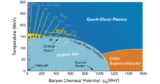 Read article 'Quark-matter fireballs hashed out in Protvino'
The XXXII international workshop of the Logunov Institute focused on “hot problems in hot and cold quark matter”.
 Read article 'Cosmic plasma-wakefield acceleration'
Recent studies suggest that plasma-wakefield acceleration also occurs naturally, potentially explaining the highest energy cosmic rays.
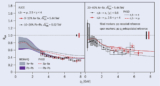 Read article 'Heavy flavours probe QGP geometry'
While plumbing transverse momenta of 200 MeV for the first time, new results from the ALICE collaboration demonstrate the impact of collision geometry on heavy-quark energy loss.