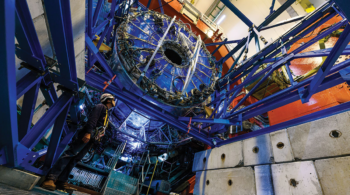

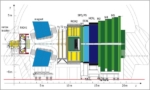
 Read article 'LHCb prepares for a RICH harvest of rare beauty'
LHCb prepares for a RICH harvest of rare beauty
RICH detectors get ready for heavy-flavour physics at the LHC.
 Read article 'LHCb prepares for a RICH harvest of rare beauty'
RICH detectors get ready for heavy-flavour physics at the LHC.
 Read article 'Borexino begins data taking at Gran Sasso'
The Borexino detector is now fully operational at the Laboratori Nazionali del Gran Sasso.
 Read article 'VIRGO opens up new astronomy'
On 18 May, the Virgo laser interferometer for the detection of gravitational waves started its first science run at the European Gravitational Observatory, Pisa, marking a step forward towards a new ...
 Read article 'THEMIS spacecraft take thin-contact silicon into orbit'
Particle detectors developed for high-energy and nuclear physics often find uses in many other fields. Now silicon detectors with thin entrance contacts have been launched into space aboard the five s...
 Read article 'The last module of LHCb’s VELO arrives'
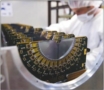
After 10 years of hard work the last of the 42 modules for the LHCb Vertex Locator (VELO) arrived at CERN in early March.
 Read article 'The Inner Tracking System arrives at the heart of ALICE'
On 15 March 100 physicists and engineers gathered in the ALICE underground cavern to witness the end of a 15 year journey of development, construction, commissioning and testing before the Inner Tr...
 Read article 'CMS celebrates the arrival of the last crystals'
The last of the 62,960 lead tungstate crystals arrived at CERN on 9 March, marking the end of a 15 year project for the CMS experiment and the Crystal Clear Collaboration.
 Read article 'Solving the mystery of the missing neutrinos'
In the May 2007 issue, Nick Jelley and Alan Poon looked back at the achievements of the SNO experiment.
 Read article 'Spark-proof GEM gives higher gain'
A team from CERN and INFN has developed the resistive-electrode thick GEM, or RETGEM, which offers a high gain while being intrinsically protected against sparks.
 Read article 'CMS solenoid makes successful descent'
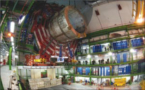
At 6.00 a.m. on 28 February the heaviest section of the Compact Muon Solenoid (CMS) detector began its momentous journey into the experiment's cavern, 100 m below ground.