
 Read article 'GLAST in orbit to explore extreme universe'
GLAST in orbit to explore extreme universe
The Gamma-Ray Large Area Space Telescope (GLAST) was launched by NASA on 11 June from the Cape Canaveral Air Force Station in Florida.
 Read article 'GLAST in orbit to explore extreme universe'
The Gamma-Ray Large Area Space Telescope (GLAST) was launched by NASA on 11 June from the Cape Canaveral Air Force Station in Florida.
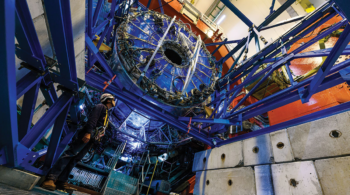
 Read article 'ATLAS: where big wheels are really big'
A look at the huge endcap systems for the ATLAS muon spectrometer.
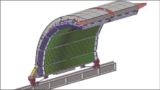 Read article 'ALICE joins jet set'
Peter Jacobs describes the electromagnetic calorimeter that will study jets.
 Read article 'Milagro maps out gamma-ray frontier'
Impressive results from this extensive air shower detector in New Mexico.
 Read article 'DAMA strengthens claim of annual modulation with new intriguing evidence'
Nine years ago the DAMA collaboration announced intriguing evidence for an annual modulation in the signals in its detectors, which could be evidence of dark-matter particles in the galactic halo.
 Read article '…while CMS completes crystal calorimeter'
The final crystals for the CMS electromagnetic calorimeter (ECAL) arrived from China and Russia at CERN in March, completing a mammoth production process nearly 10 years after the delivery of the fir...
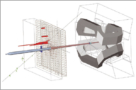 Read article 'LHCb measures its first cosmic-ray muons…'
The LHCb team has for the first time measured cosmic rays passing through three of the experiment’s subdetectors simultaneously, selected by muon triggers.
Read article 'Trieste workshop puts a RICH variety on show'
Ring imaging Cherenkov (RICH) counters provide a unique tool to identify charged particles by measuring their velocity, even when it differs from the velocity of light by only one part in 10 million....
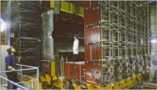 Read article 'UA1 magnet sets off for a second new life'
A magnet built originally for the UA1 detector at CERN and later used by the NOMAD experiment has set sail for a new life in Japan.
Read article '…while LHCb gets data collection on track'
On 8 February, the LHCb collaboration succeeded in extracting data from an almost-complete set of detectors.