

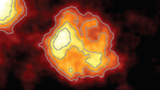
 Read article 'HESS proves the power of TeV astronomy'
HESS proves the power of TeV astronomy
To celebrate its 15th anniversary, the HESS collaboration has published its largest set of scientific results to date.
 Read article 'HESS proves the power of TeV astronomy'
To celebrate its 15th anniversary, the HESS collaboration has published its largest set of scientific results to date.
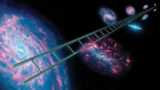 Read article 'Hubble expansion discrepancy deepens'
Adam Riess from the Space Telescope Science Institute and colleagues have now made a more precise, direct measurement that reinforces the mismatch and could signal new physics.
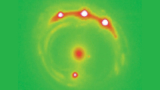 Read article 'Spotting the first extragalactic planets'
Radiation emitted around a distant black hole has revealed the existence of extragalactic planets in a galaxy 3.8 billion light years away.
 Read article 'Europe defines astroparticle strategy'
Multi-messenger astronomy, neutrino physics and dark matter are among several topics set to take priority in Europe, according to a report by the Astroparticle Physics European Consortium (APPEC).
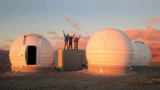 Read article 'ESO'
A new national facility at La Silla Observatory in Chile, operated by the European Southern Observatory (ESO), made its first observations at the beginning of the year.
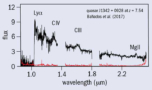 Read article 'Ancient black hole lights up early universe'
The spectrum of J1342+0928 gives us a view on the universe when it was just 690 million years old.
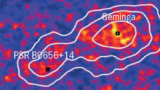 Read article 'HAWC clarifies cosmic positron excess'
New measurements by the High-Altitude Water Cherenkov (HAWC) experiment hints at a more exotic origin of the positron excess.
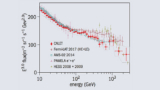 Read article 'First cosmic-ray results from CALET on the ISS'
The CALorimetric Electron Telescope (CALET) has released its first results concerning the nature of high-energy cosmic rays.
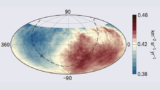 Read article 'Extreme cosmic rays reveal clues to origin'
The Pierre Auger collaboration has published results showing that the arrival direction of ultra-high-energy cosmic rays (UHECRs) is far from uniform.
 Read article 'Gravitational waves and the birth of a new science'
The era of multi-messenger astronomy is here, calling for next-generation gravitational-wave observatories.